

Podcasting has seen strong growth over the past few years, and 2026 may well turn out to be its strongest year yet.
Netflix has just begun its serious podcast experiment, with sports podcasts leading the way.
The Golden Globe just handed out its inaugural Best Podcast award to ‘Good Hang With Amy Poehler’.
Video podcasts are no longer a novelty, and public figures are launching new shows at a pace that would have felt unrealistic not long ago. Platforms that once treated podcasts as an afterthought are actively competing for them.
Taken together, all of this looks like straightforward progress for the podcasting industry worth cheering.
Look a little closer, though, and a more interesting shift is taking place.
Podcasting is in the middle of an identity crisis.
Not just because the medium is evolving, but because it is expanding faster than our definitions, habits and expectations can comfortably keep up.
Increasingly, people are discovering podcasts for the first time on YouTube than “hearing” them on Apple Podcasts or Spotify.
Which means, if you are thinking about starting a podcast this year, understanding this shift in the context of the overall podcast trends in 2026 matters far more than deciding which microphone or camera to buy.
Table of Contents
How video podcasts are driving podcast trends in 2026
There is very little disagreement about this now. The biggest driver of podcast growth over the past two years has been video.

YouTube has quietly become one of the world’s largest podcast platforms, with 40% of the audience share. Spotify continues to push video higher up its product roadmap. Short clips on TikTok and Instagram have become the primary discovery mechanism for many long-form shows.
Even creators who once insisted on staying audio-only have started adding cameras, sometimes out of curiosity, sometimes out of necessity.
What often gets overlooked is how much this shift has changed creative priorities.
When podcasting was predominantly audio-first, most optimisation happened at the level of thinking and structure.
Hosts worried about clarity, pacing and whether an idea could hold attention over thirty or forty minutes. Editing focused on flow rather than spectacle in the forn of flying overlays.
As video becomes more central, attention naturally drifts towards visuals.
Presence on camera matters. Sets, lighting and facial reactions affect engagement. Content is increasingly judged in short bursts before anyone commits to the full episode.
None of this is inherently problematic. What is becoming noticeable, however, is the quiet neglect of audio-only listeners.
Gestures and visual demonstrations are increasingly left unexplained in words, leaving those who are listening rather than watching to wonder what they have missed.
Case in point — check out this podcast interview with a sleep expert on The Diary of A Ceo.
The Diary of A CEO podcast had its roots as an audio-only format podcast when it first started in 2017, and one thing I have always appreciated about Steven Bartlett is his sensitivity to the medium. He still addresses his audience as “listeners” rather than “viewers” up to this day.
But, in this episode, as he handed a jar of gold coins to his expert guest, Dr Matthew Walker, to illustrate the idea of a “sleep bank”, Walker’s explanation relied heavily on the visual demonstration, with little verbal signposting.
For those few minutes (11’09 – 14’00), podcast listeners became visually handicapped by the lack of audio cues.
How are video podcasts redefining what a podcast is?
Video has undeniably helped podcasts break out of their niches and reach much larger audiences. But it does subtly change what many shows are built around. That shift is already further influencing how podcasts are perceived, and it will likely shape how the medium is understood in the years ahead.
When entrepreneur-turned-marketing-professor-turned-hit-podcaster Scott Galloway remarked in 2025 that the future of podcasting is video, the reaction was mixed.
Many creators agreed. A sizeable portion of listeners did not. Spend a few minutes on Reddit or creator forums and the resistance becomes clear. For them, video feels less like an evolution and more like a departure from what podcasting was meant to be
The untidy truth is that podcasting has never had a perfectly neat definition to begin with.
Is a podcast defined by its content, its presentation, or the platform that delivers it?
A brief primer on the evolution of podcasts
In its earliest form, a podcast was generally understood to be audio-first, distributed on demand, and designed to be listened to rather than watched. The underlying concept dates back to December 2000, when developers figured out how to attach audio files to an RSS feed. Until then, RSS had mainly been used by blogs and news sites to syndicate written content.
The launch of the iPod a year later gave this idea its cultural moment. Users began downloading and automatically updating what were essentially “online radio shows” onto their devices. The term “podcast”, a portmanteau of “iPod” and “broadcast”, was born and eventually became a genre category on its own within iTunes in June 2005.
For context, YouTube was only publicly launched six months after that, in December 2005, leveraging on the same RSS technology but this time for videos.
It took nearly two decades before the paths of “podcasts” and “YouTube” converged officially in March 2023 , with the introduction of the dedicated podcast feature on the YouTube platform. In the years leading up to that moment, many shows had already begun to blur the boundaries. The Joe Rogan Experience appeared on YouTube as early as 2013, The Diary of A CEO in 2019, and during the pandemic, celebrity-led podcasts such as Oprah Winfrey’s SuperSoul Conversations and Russell Brand’s Under the Skin accelerated the shift further.
What Makes a Podcast
By the time platforms caught up in introducing video to podcasts, audience behaviour already had. So, in the last two years, I started asking, “What makes a podcast… a “podcast”?”
Or essentially, what qualifies a talk show, a conversation or an interview as a podcast? And just as importantly, when does it stop being one?
If William Shakespeare were still alive today, he would be asking, “That which we call a podcast, by any other name would still sound as such?”
As the medium has moved from an audio-based RSS technology into a recognised content category spanning Apple Podcasts, Spotify, YouTube, Netflix and even awards ceremonies like the Golden Globes, its definition has quietly shifted. Podcasts are no longer defined primarily by how they are delivered but more as a content genre.
There was a time when content distributed via Apple Podcasts or Spotify would almost automatically qualify as a podcast. That boundary blurred as creators began leveraging YouTube’s vastly superior discovery and recommendation engine to expand their shows’ reach.
With studio sets, multiple cameras, sponsorship segments and celebrity guests, many shows now resemble a format that from the golden era of cable television. At that point, the distinction between a podcast and a streaming talk show becomes less obvious.
There is little value in arguing too rigidly over labels, or even whether you need visible large-diaphragm mics in front of the speakers to make it distinctively a podcast.
Podcasting has never stood still, and there is no reason it should now. What matters more is recognising how these shifts affect funding, audience behaviour, advertising revenues and production priorities.
And this is where the next acceleration becomes easier to understand.
Why celebrity podcasts are accelerating the podcast boom
As podcasts become less tied to delivery and more to visibility, celebrity-led shows are now beginning to play a disproportionate role in shaping expectations of what podcasts should sound like, look like, and be.
When public figures launch podcasts with existing audiences, high production budgets and strong platform backing, they establish a highly visible reference point for what “successful” podcasting appears to look like. These shows are easier to notice, easier to promote and easier for platforms to rally around.
Such visibility has a knock-on effect.
As celebrity podcasts rise to the top of charts and recommendation feeds, brands, businesses and organisations begin to ask whether they should have a podcast of their own.
In principle, this is sensible. But, in practice, the vanity metrics they reach for are often the wrong ones.
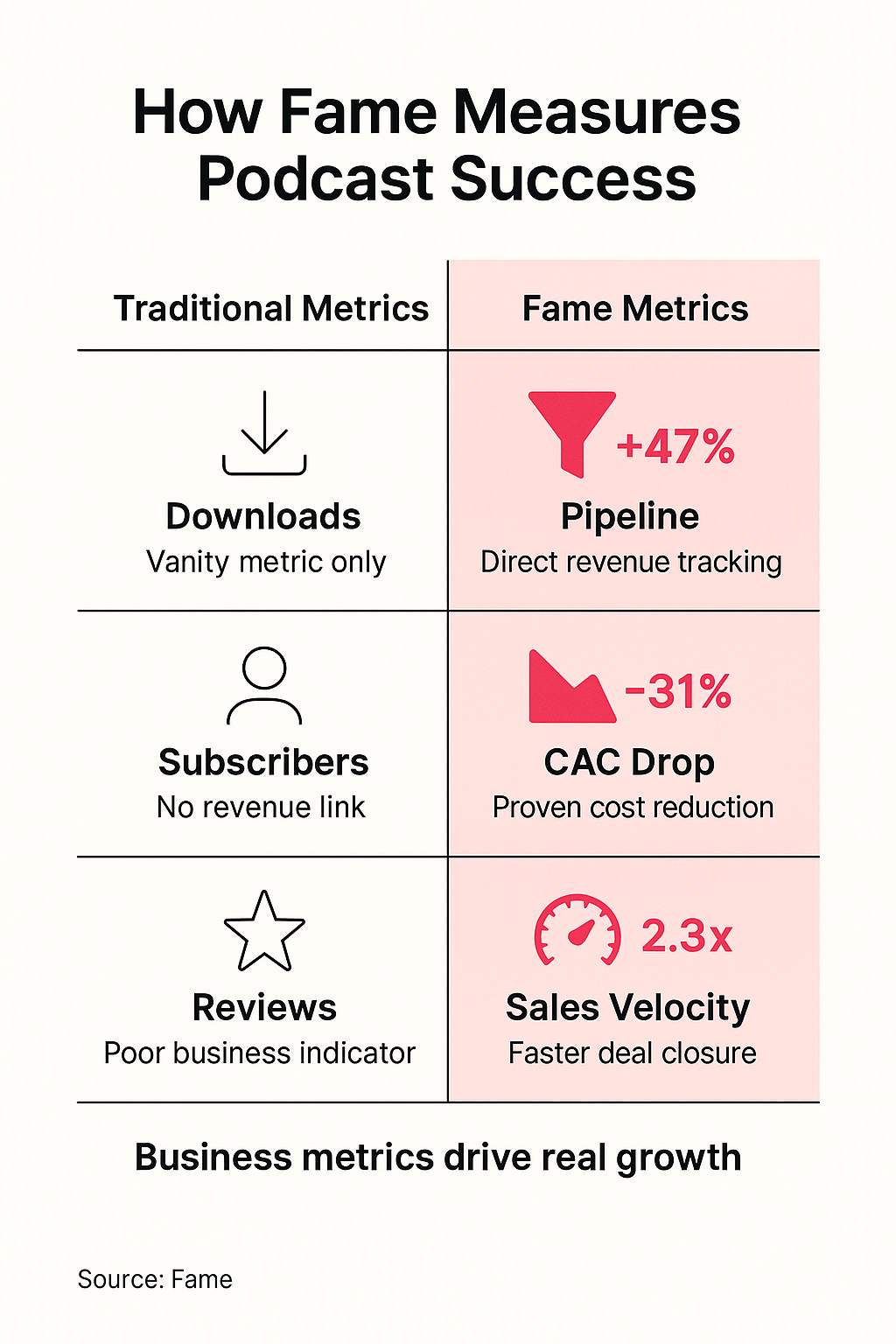
Success becomes associated with scale. Downloads, views, subscriber counts and chart positions begin to stand in for impact. Podcasting starts to be evaluated through the same lens as viral content or social media reach.
This is where imitation begins to distort intent.
Celebrity podcasts represent one end of the spectrum, much like a number one hit on the Billboard charts. They are designed for mass appeal, visibility and momentum. There is nothing inherently wrong with that.
But celebrity podcasts are only one expression of what podcasting can be.
Most podcasts do not exist in that world. Their goals are different. Their audiences are smaller but more specific. Their resources, timelines and priorities bear little resemblance to those of a celebrity-led production.
Yet many brands or businesses are still conceptualising shows as if the goal is to produce a breakout hit.
In reality, the value of a podcast for many audiences has far less to do with being number one, and far more to do with being reliable. You may think you need a chart-topping single to be deemed successful, but a great podcast is more equivalent to what the favourite neighbourhood café is to the audience. Not something consumed once and forgotten, but something people return to regularly, almost habitually, because it fits into their lives.
These podcasts may never dominate charts or trend on social media. But they build trust in your brand or business, and morph into a form or parasocial connection over time.
Understanding this distinction matters, because it shapes how podcasts are planned, funded and sustained. And it helps explain why celebrity-led shows, while highly visible, should not be the blueprint for most creators.
Will AI-generated podcasts replace human hosts and guests?
Alongside the shift towards video-first podcasting, there is another parallel trend quietly gathering momentum: the use of AI to generate podcasts at scale in order to keep up with the perceived demand for attention.
AI tools that summarise articles, generate scripts, clone voices and assemble full episodes already exist. Notebook LLM, for instance, now allows users to turn a written article into a two-person conversational podcast with minimal effort.
From a purely operational standpoint, the appeal is obvious. Producing more content in less time has always been attractive, especially in an increasingly crowded landscape where visibility feels scarce and competition feels relentless.
What this is more likely to produce, however, is not a wave of enduring AI-led podcasts, but a large volume of short-lived ones (podfading after less thean 5 episodes).
We have seen this pattern play out repeatedly across other forms of content. When audiences realise that something presented as thoughtful or expressive is largely “artificially generated“, the reaction can be surprisingly visceral. The backlash is rarely about the technology itself; it is about the sense that human effort has been quietly removed.
Like the widely criticised McDonald’s Netherlands Christmas campaign last December.
The immediate backlash was less swift and unforgiving, driven less by the use of AI than by what critics described as a hollow, effort-light form of creativity, often dismissed as AI slop.
Although the agency later clarified that the campaign involved seven weeks of laborious, careful work and iteration, the explanation arrived too late. By then, the emotional verdict had already been delivered.
“For seven weeks, we hardly slept, with up to 10 of our in-house AI and post specialists at The Gardening Club [our in-house AI engine] working in lockstep with the directors.
I don’t see this spot as a novelty or a cute seasonal experiment. To me, it’s evidence of something much bigger: that when craft and technology meet with intention, they can create work that feels genuinely cinematic.
So no – AI didn’t make this film. We did.
Melanie Bridge, CEO of The Sweetshop (the production house behind the Netherlands McDonald’s Christmas advertisment
For brands and businesses experimenting with fully AI-generated podcasts or voice clones, this should prompt a pause.
Speed and scale may reduce production time and even free up budget for distribution, but they do little to build something that listeners actually want to return to
The podcast experience is unusually intimate. People consume them while driving, exercising, cooking or thinking. Over time, a podcast stops feeling like content and starts to resemble time spent with a particular voice or way of seeing the world.
That relationship is difficult to replicate automatically without human input. Many AI-generated podcasts will struggle to earn trust or sustain attention over time, and will instead join a growing archive of abandoned feeds, quietly left behind.
In its own way, this is a healthy signal. It suggests that podcasting still rewards human presence, perspective and intent more than sheer output.
The future of podcasting: A space for thought-led content
If celebrity-led shows represent one end of the podcasting spectrum, and AI-slop podcasts the other, then the future of the medium will not be defined by trying to compete at either end.
Most podcasts do not have celebrities, TV studio budgets or built-in audiences. And that is not a weakness. It is simply a different use of the medium.
It will not replace YouTube, nor will it function best as a cheaper version of a television talk show.
Instead, away from the glamour and simply being a numbers game for advertising revenue, podcasting will evolve into a thought-led medium — a space for original thought, informed opinion, expert insight and conversations.
This is where podcasts distinguish themselves from an increasingly crowded visual content ecosystem.
Depth survives, whereas spectacle quickly expires in TikTok fashion. In a landscape increasingly filled with AI summaries, recycled opinions, and algorithm-friendly noise, podcasts remain one of the few formats where ideas can unfold slowly. People talk things through. They change their minds mid-sentence. They sit with uncertainty rather than rushing to conclusions.
It’s almost like the sacred space where thinking is still allowed to take place in full sentences.
This is also why podcasts will retain a particular appeal to intellectually curious audiences. They are not looking to be dazzled, but to be engaged. They will tune in for depth, nuance and the feeling of being invited into a line of reasoning rather than sold a conclusion.
As the wider content economy accelerates towards speed and volume, the podcasts that last will behave less like media products and more like intellectual spaces. They become places where creators, practitioners and experts speak plainly, share what they have actually learned, and trust that the right audience will return.
So, for brands and businesses, this requires reframing of intent when starting or running a podcast.
Who are you really trying to reach through such a niche medium?
When you tell a client or prospect that you have a podcast, what kind of intellectual space do you want them to imagine, compared to saying you are active on Instagram or TikTok?
The shift in how the masses perceive podcasting, driven by the evolving trends discussed, would be where podcasting finds its foothold in an increasingly hyper-visual content ecosystem. Not as a cheaper form of video or an AI-assisted content engine, but as one of the few mediums that still rewards human presence, judgement and intent.
Key Takeaways: If You Only Remember a Few Things About Podcasting in 2026
1. Start with intent, not format
Video or audio is a secondary decision. What matters first is why the podcast exists and who it is for.
Is it meant to clarify your thinking, build trust with a specific audience, or create a body of work people can explore over time? Those answers should shape everything else, including whether nitty-gritty video details or special effects even adds value.
2. Celebrity podcasts are a signal of attention, not a model for success
Celebrity-led shows are highly visible, but they operate under entirely different constraints. They are closer to chart-topping hits than everyday listening.
For most podcasts, especially those run by brands, businesses or practitioners, success looks more like being a familiar presence. Something your audience returns to regularly because it fits into their routines and thinking, not because it dominates headlines.
3. AI can reduce friction, but it cannot replace unique perspectives
AI tools will make podcast production faster and cheaper. Used well, they remove friction behind the scenes.
Used as a substitute for thinking, they hollow the content out. Audiences are quick to sense when a show lacks judgement, insights or genuine effort in thought.
4. Optimise for trust before reach
Podcasts are consumed differently from most media. They are listened or watched in private moments, often repeatedly.
That intimacy rewards consistency, clarity and a recognisable voice far more than novelty or scale. Many valuable podcasts grow slowly, then quietly become indispensable.
5. Treat your podcast as an intellectual asset, not a content channel
Over time, a podcast becomes a record of how you think. It does work long after an episode is published.
For the right audience, that accumulated thinking can be more persuasive than any campaign, pitch deck or social post.
Seen this way, podcasting’s expansion into video platforms, award shows and streaming services feels less like a break from its past and more like a moment of adjustment. As the medium stretches across YouTube, Netflix and whatever comes next, some shows will inevitably chase scale and visibility. Others will do something simpler. They will remain clear about why they exist and who they are for. In an increasingly loud and visual content landscape, podcasting’s advantage has not disappeared. It has just become easier to miss if you aren’t careful as a podcaster.
Get a copy of “The 9-Step Standout Podcast Formula” to make sure your podcast get seen, heard and followed: